
Your Shopping Cart

OTHER PRODUCTS
-
 My Store
Fish Resin Craft 088
Regular price Rs. 7,200.00Regular priceUnit price perRs. 10,500.00Sale price Rs. 7,200.00 -
 My Store
Sri Swaminathan & Co Premium Gold Finish Resin Seven Carps Archway Statue (33 cm / 13 Inch)
Regular price Rs. 5,500.00Regular priceUnit price perRs. 9,500.00Sale price Rs. 5,500.00 -
 My Store
Sri Swaminathan & Co Royal Gold Dust Resin Nine Carps Wealth Pot Statue (24 cm / 9.5 Inch)
Regular price Rs. 2,850.00Regular priceUnit price perRs. 5,750.00Sale price Rs. 2,850.00


Sri Swaminathan & Co
INCLUSIVE OF ALL TAXES
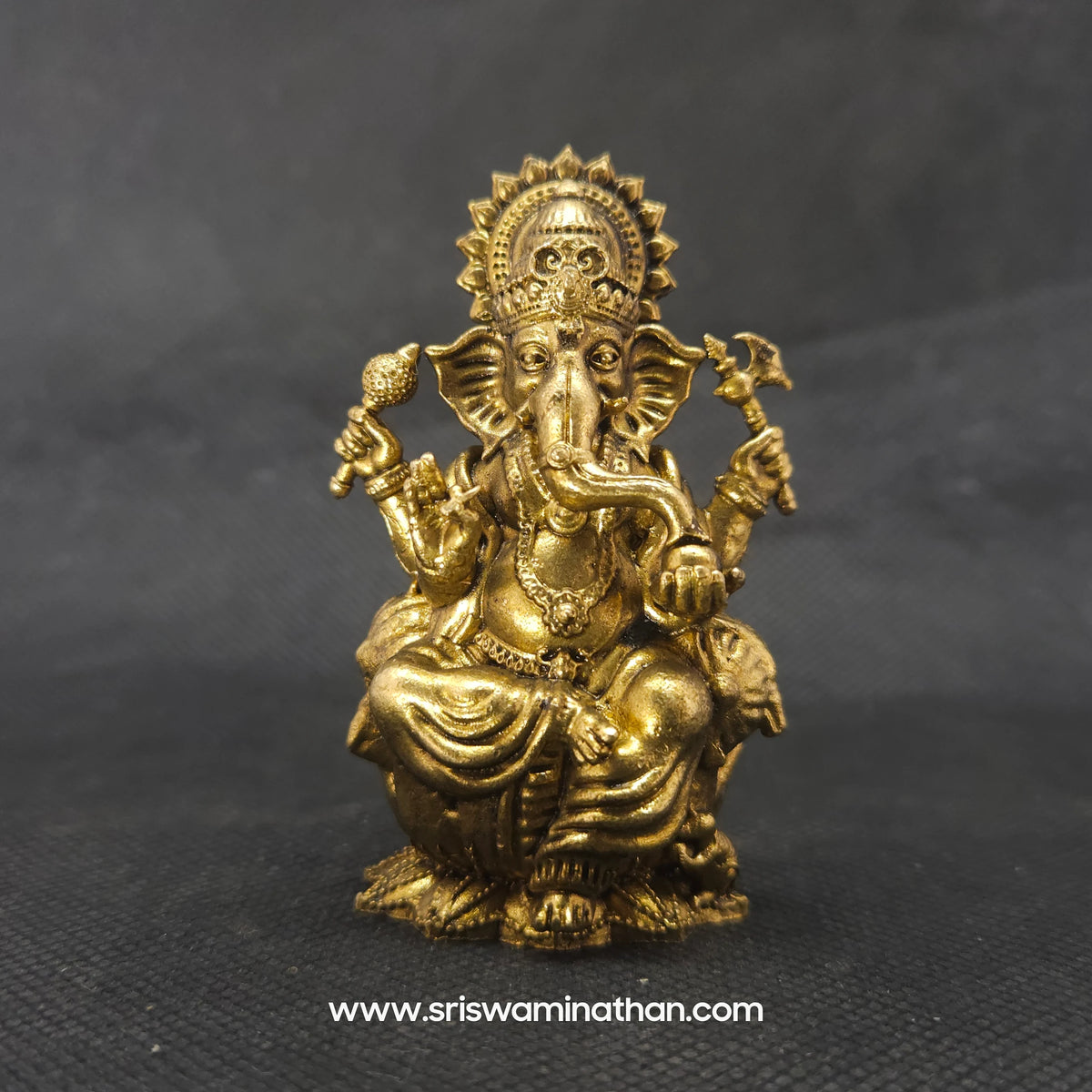
Premium Brass 3D craft Ekadanta Ganapati
Premium Brass 3D craft Ekadanta Ganapati
Regular price
Rs. 210.00
Regular price
Rs. 285.00
Sale price
Rs. 210.00
Unit price
per
Shipping calculated at checkout.
SKU : 15682
Availability : In Stock
🚚 Free Shipping in India
above ₹1,000 | International shipping available
above ₹1,000 | International shipping available
📦 Safe Delivery
Zero Breakage Guarantee
Zero Breakage Guarantee
📹 WhatsApp Video
Before We Dispatch
Before We Dispatch
✅ Real Product Photos
No Filters. No AI.
No Filters. No AI.
🏆 53 Years of Trust
Kumbakonam's Finest
Kumbakonam's Finest
Couldn't load pickup availability
Shipping & Returns
Shipping & Returns
🚚 free shipping on all orders above ₹1,000 for India delivery only.
Tamil Nadu: 1-3 days
South India (outside Tamil Nadu): 2–5 days
Rest of India: 5–10 days
🌍 International shipping - International shipping charges will be added to the product price.
Call or WhatsApp us for shipping cost before ordering


Sri Swaminathan & Co · Since 1973 · Sacred Trust
Ekadanta Ganapati — The One-Tusked Lord of Sacred Sacrifice & Supreme Wisdom
3D Brass Elite Collection · Premium Sacred Art · Museum-Quality Casting · Tamil Nadu
“His quill broke mid-verse. The Mahabharata could not pause. Without hesitation, he snapped off his own tusk and continued writing. Not because he had to. Because he had promised. Ekadanta Ganapati is the god who taught the world that when you give everything for what truly matters — nothing is lost. Everything is gained.”
Ekadanta Ganapati — the One-Tusked Lord — is among the most philosophically profound of the 32 sacred Ganesha forms described in the Mudgala Purana. Where the common image of Ganesha shows two intact tusks, Ekadanta stands with his right tusk broken, held proudly in his own hand — not as a wound, not as a loss, but as his greatest instrument. The broken tusk wrote the Mahabharata. The broken tusk became the pen with which the longest, most profound epic in human history was committed to eternal record. This is not a form of Ganesha showing limitation. This is the form showing what becomes possible when a being sacrifices without hesitation for a purpose greater than himself. This 100% solid premium brass statue, cast using high-precision 3D detailed craft techniques by our master artisans, brings this extraordinary form and everything it carries — dedication, wisdom, creative mastery, and sacred sacrifice — directly into your altar and your home.
The Story of the Broken Tusk — The Night That Changed Everything
The great sage Veda Vyasa had received the complete Mahabharata in his mind — all 100,000 verses, every battle, every philosophy, every moment of the longest story ever told. But he could not write it alone. The divine vision came faster than any human hand could follow. The gods knew only one being whose mind was vast enough, and whose hand was swift enough, to serve as scribe for such an undertaking. They recommended Lord Ganesha.
Ganesha agreed — but on one condition: Vyasa must dictate without pause. Not for a moment. Not for a breath. If the words stopped, the writing stopped. Vyasa accepted, but added his own condition in return: Ganesha must understand every verse completely before committing it to writing. And so the great composing began. Verse after verse. Battle after battle. Philosophy after philosophy. The words flowed. The writing kept pace.
Then the writing quill broke. A lesser being would have paused. Would have sought another quill. Would have broken the promise. Ganesha did not pause for even a single moment. He reached up, broke off his own right tusk, and continued writing — the Mahabharata uninterrupted, the promise unbroken, the epic complete. The broken tusk became the instrument of the greatest literary act in human history. It is the tusk he still holds in his hand today — proudly, for there is no greater honour than what it wrote.
▶ His Four Sacred Hands — What They Hold & Why
The Broken Tusk — Eka Danta
Held in one hand not as a wound but as a trophy of sacred sacrifice. The tusk that wrote the Mahabharata is the most powerful writing instrument in cosmic history. For students, writers, scholars, and creators, this tusk held in the god’s hand is a direct blessing: your dedication, your sacrifice for your craft, will produce something lasting.
Modaka — The Sweet of Wisdom
The Modaka — a sweet dumpling — is held in another hand as the reward of true learning. On the outside it is hard to make; inside it is soft, sweet, and nourishing. This is the exact nature of genuine knowledge: it takes discipline and effort to acquire, but once received, it nourishes the soul in ways that nothing else can. The Modaka is Ganesha’s promise: effort leads to sweetness.
Aksha Mala — The Prayer Beads
Prayer beads draped across his palm — the symbol of disciplined, sustained practice. Knowledge does not come in one flash of inspiration. It comes through repetition, through daily dedication, through the willingness to return to the practice even when it is difficult. The Aksha Mala is Ekadanta’s reminder: keep coming back. Mastery lives on the other side of consistency.
Parashu — The Sacred Axe
The axe that cuts through ignorance, false knowledge, and the ego that blocks genuine learning. Before the Mahabharata could be written, all assumptions had to be set aside. All pride had to be broken. Ekadanta holds the Parashu as a reminder that the greatest obstacle to wisdom is not lack of intelligence — it is the belief that one already knows.
The Broken Tusk — Eka Danta
Held in one hand not as a wound but as a trophy of sacred sacrifice. The tusk that wrote the Mahabharata is the most powerful writing instrument in cosmic history. For students, writers, scholars, and creators, this tusk held in the god’s hand is a direct blessing: your dedication, your sacrifice for your craft, will produce something lasting.
Modaka — The Sweet of Wisdom
The Modaka — a sweet dumpling — is held in another hand as the reward of true learning. On the outside it is hard to make; inside it is soft, sweet, and nourishing. This is the exact nature of genuine knowledge: it takes discipline and effort to acquire, but once received, it nourishes the soul in ways that nothing else can. The Modaka is Ganesha’s promise: effort leads to sweetness.
Aksha Mala — The Prayer Beads
Prayer beads draped across his palm — the symbol of disciplined, sustained practice. Knowledge does not come in one flash of inspiration. It comes through repetition, through daily dedication, through the willingness to return to the practice even when it is difficult. The Aksha Mala is Ekadanta’s reminder: keep coming back. Mastery lives on the other side of consistency.
Parashu — The Sacred Axe
The axe that cuts through ignorance, false knowledge, and the ego that blocks genuine learning. Before the Mahabharata could be written, all assumptions had to be set aside. All pride had to be broken. Ekadanta holds the Parashu as a reminder that the greatest obstacle to wisdom is not lack of intelligence — it is the belief that one already knows.
His Scriptural Form
The Mudgala Purana describes Ekadanta Ganapati as smoky blue in complexion — the colour of the evening sky just before stars appear, the moment between knowing and not-yet-knowing, the sacred threshold of understanding. His belly is large and generous — the sign of one who has consumed and digested the entirety of knowledge without being overwhelmed by it. His expression is one of calm, concentrated wisdom — not the playful ease of Lalita Ganapati, not the fierce power of other forms, but the settled, deep, unhurried composure of a being who has seen everything and understands it all. His trunk curves naturally. His crown is present but unobtrusive — for Ekadanta’s true crown is the broken tusk he holds.
The Sacred Blessings He Bestows
- Academic Excellence — the patron deity of students. His presence on a study desk is among the most powerful academic blessings in the tradition. Exams, entrance tests, competitive studies — he is the one to invoke.
- Creative Mastery — writers, poets, musicians, and artists who worship Ekadanta find that creative blocks dissolve and the work flows with new depth and clarity.
- Sacred Dedication — the courage to give everything to what truly matters, without calculating the cost. The broken tusk blessing.
- Unbroken Commitment — the ability to keep a promise even when circumstances make it difficult. Ekadanta broke his tusk rather than break his word.
- Destruction of Ignorance — the Parashu in his hand actively clears false knowledge, intellectual arrogance, and the blocks that prevent genuine understanding.
- Sweet Reward of Effort — the Modaka’s promise: sustained effort leads to genuine, lasting satisfaction. Not fleeting pleasure — deep nourishment.
- Disciplined Practice — the Aksha Mala blesses all who need the strength to return to their practice daily, especially those in long-term learning, skill-building, or spiritual sadhana.
- Obstacle Removal in Knowledge Pursuits — as the first son of Shiva and Parvati, he clears the obstacles specific to the path of learning: distraction, doubt, discouragement, and the feeling that one is not capable enough.
Premium Solid Metal Artistry
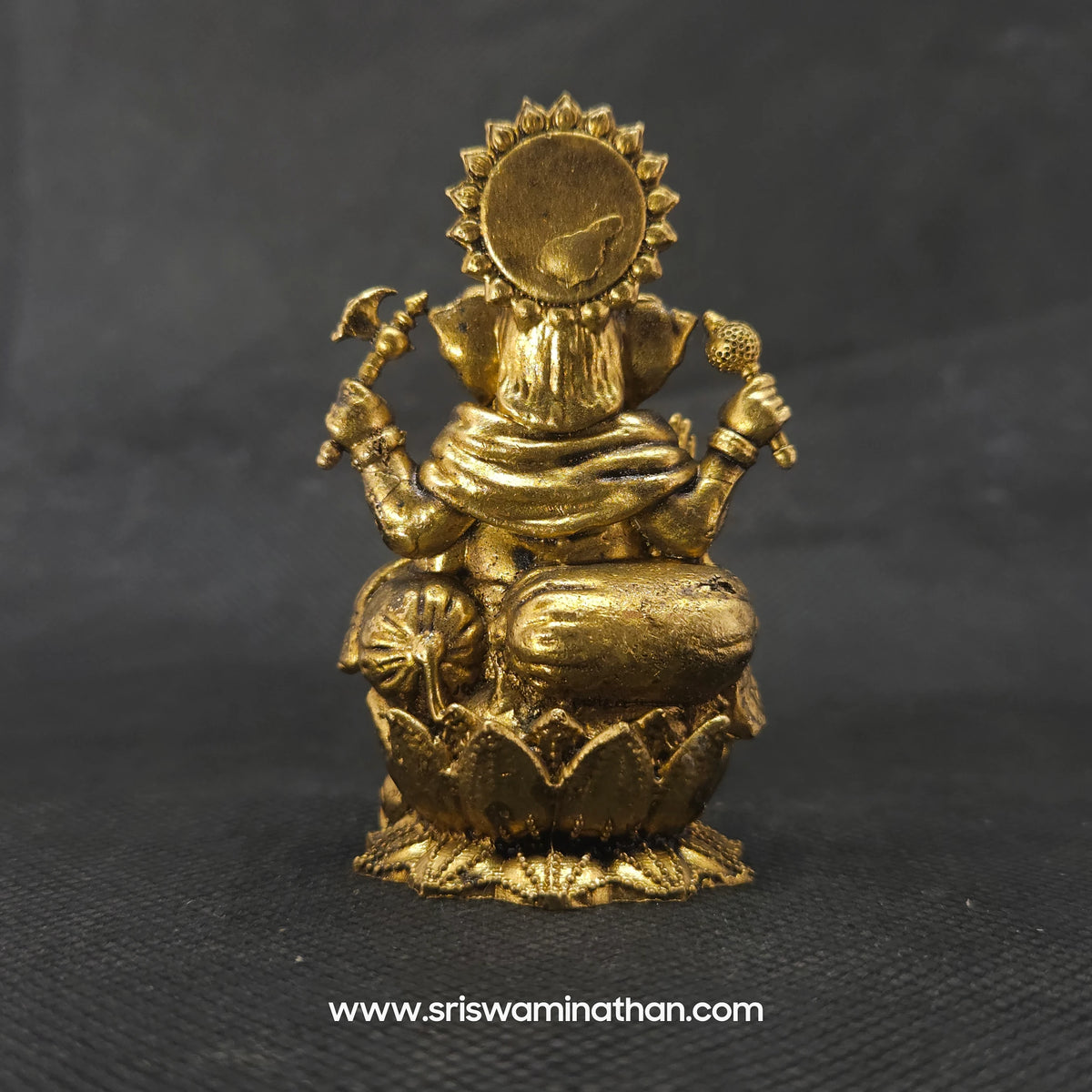
This masterwork is cast from 100% solid premium brass using high-precision 3D detailed craft finishing techniques — zero hollow spaces, no gold spray-paint. Look closely at the broken tusk held in his hand, the rounded Modaka, the prayer beads of the Aksha Mala, and the sacred Parashu — each element rendered with museum-quality depth. The fine detail of his crown, the curve of his trunk, and the generous proportion of his form are all captured in true 3D relief. The warm golden glow of hand-polished brass gives the idol a natural, lamp-lit radiance that grows more beautiful as it ages. Built to handle generations of daily worship.
▶ Important Note — Where Tradition Becomes Immortal
Every millimetre of this idol is the result of a living South Indian artisan heritage — families who have devoted generations to the mastery of 3D brass moulding. What leaves our workshop is not a product. It is a god who sacrificed everything for wisdom, cast in brass, and built to bless your home and everyone who studies, creates, or strives within it — for generations.
Every millimetre of this idol is the result of a living South Indian artisan heritage — families who have devoted generations to the mastery of 3D brass moulding. What leaves our workshop is not a product. It is a god who sacrificed everything for wisdom, cast in brass, and built to bless your home and everyone who studies, creates, or strives within it — for generations.
Altar Size Specifications
| Specification | 1.5" | 2.0" | 2.25" | 2.5" |
|---|---|---|---|---|
| Height | 4.0 cm 1.6 inch |
5.0 cm 2.0 inch |
5.5 cm 2.2 inch |
6.5 cm 2.6 inch |
| Length | 2.0 cm 0.8 inch |
2.5 cm 1.0 inch |
3.5 cm 1.4 inch |
3.6 cm 1.4 inch |
| Depth | 1.5 cm 0.6 inch |
2.0 cm 0.8 inch |
2.5 cm 1.0 inch |
3.0 cm 1.2 inch |
| Weight | ~25 g 0.9 oz |
~60 g 2.1 oz |
~75 g 2.6 oz |
~125 g 4.4 oz |
| Best Placement Indian |
Study table, personal pooja tray, exam desk | Pooja shelf, home study altar, daily worship | Mandir padi, home temple, writing space | Home temple centrepiece, library altar |
| Best Placement Global |
Desk corner, student altar, travel kit | Home office shrine, apartment altar, bookshelf | Writer’s desk, meditation corner, creative workspace | Primary home shrine, library centrepiece |
All sizes are solid brass with identical 3D detail quality. Weights are approximate and may vary slightly.
Auspicious Occasions & Gifting
▶ Perfect for These Sacred Occasions
Vinayaka Chaturthi · Ganesh Chaturthi · Saraswati Puja · Ayudha Puja · Vijayadasami · Housewarming · Wedding gifts · Corporate gifting
Especially meaningful as a gift for students appearing for board exams, entrance examinations, or competitive tests · writers and authors beginning a new work · researchers and academics · musicians and artists deepening their craft · anyone beginning a long-term learning journey. The 1.5" size sits perfectly on any study desk. The 2" and 2.25" sizes are ideal for home temples and creative workspaces. The 2.5" size is the premium choice for libraries, home shrines, and significant gifting occasions. Recognised and treasured by devotees across India, Malaysia, Singapore, the Gulf, UK, and Australia.
Vinayaka Chaturthi · Ganesh Chaturthi · Saraswati Puja · Ayudha Puja · Vijayadasami · Housewarming · Wedding gifts · Corporate gifting
Especially meaningful as a gift for students appearing for board exams, entrance examinations, or competitive tests · writers and authors beginning a new work · researchers and academics · musicians and artists deepening their craft · anyone beginning a long-term learning journey. The 1.5" size sits perfectly on any study desk. The 2" and 2.25" sizes are ideal for home temples and creative workspaces. The 2.5" size is the premium choice for libraries, home shrines, and significant gifting occasions. Recognised and treasured by devotees across India, Malaysia, Singapore, the Gulf, UK, and Australia.
Cleaning & Maintenance
- Daily Dusting — wipe gently with a soft dry cloth. The prayer bead detail and broken tusk are best maintained with a soft brush.
- Gentle Washing — rinse with plain water and wipe dry with a soft cloth. Avoid letting water sit in the carved grooves of the trunk and crown.
- Avoid Harsh Chemicals — no acidic cleaners, detergents, or abrasive pads. Plain water and a soft cloth preserve all 3D relief details.
- Natural Patina — over time, brass develops a warm golden-brown patina. This is natural and deeply auspicious. To restore shine, rub gently with tamarind paste or a brass-polishing cloth.
- After Abhishekam — wipe dry immediately with a clean soft cloth to prevent water marks on the polished surface.
- Storage — store in a clean dry cloth pouch away from moisture and direct sunlight when not in active use.
“He did not mourn the tusk. He picked it up and kept writing. That is the blessing Ekadanta Ganapati carries into every home — the unshakeable knowledge that what you sacrifice for what truly matters is never lost. It becomes your greatest instrument.”
What you see on this page is the real product — photographed as it is, with no digital editing or AI enhancement. The idol you receive will look exactly as shown.
Sri Swaminathan & Co · Since 1973 · Sacred Trust
Kumbakonam · Tamil Nadu · Trusted by Devotees & Collectors Across India & the World
Care & Maintenance
Made from super fine quality brass with a golden powder coated polish — gives a satin gold glow like a gold statue. Purely for decor and dry display. If used for pooja rituals, the golden polish layer will peel off over time. Keep it dry — and it will look as fresh as the day you bought it. Always.
No restrictions for pooja rituals. Avoid harsh chemicals to preserve its traditional antique look. The dark patina is intentional — it deepens the beauty over time.
Powerful. Preferred for active pooja rituals — no restrictions. Traditional Cleaning Method: Use dara liquid and cashew nut seeds — an ancient method used by temple priests for generations. Gently rub with cashew nut seeds dipped in dara liquid. Rinse clean. Your idol will look brand new. Cleaning once every 30 days is recommended if used regularly for pooja.
Frequently Asked Questions
We understand this completely. You are buying online from a shop you have never visited. Here is the truth: Sri Swaminathan & Co has been standing at 61, Bakthapuri Street, Kumbakonam since 1973 — over 53 years. We are not a warehouse or a reseller. We are a family shop, rooted in Kumbakonam, where priests, temples, and devotees from across Tamil Nadu have been coming for generations. Travellers from Singapore, Malaysia, UK, and USA visit us when they come to Kumbakonam — because they know us. You can walk into our shop any day. We are real.
Because most sites sell products. We sell legacy. Every item in our shop — whether it is a small brass lamp or a 4-foot Panchaloha idol — comes from craftsmen whose families have been doing this since the Chola period. We do not source from factories. We do not compromise on material or finish to reduce price. When you buy from us, you are not just getting a product — you are getting 53 years of trust, traditional craftsmanship, and the assurance that what you receive is exactly what a devotee deserves.
This is a fair concern and we respect it. Here is why we do not offer COD — our products are handcrafted, fragile, and carefully packed for safe delivery. COD returns damage both the product and the trust. Instead, we offer something better: WhatsApp us before you order. We will send you a video of the actual product — the exact piece you will receive. You can ask us anything. Only when you are fully satisfied, you pay. Our 53-year reputation is our guarantee — we cannot afford to let even one customer down.
Not at all — and we are glad you asked this. Our products are made of brass and Panchaloha — metals that naturally catch and reflect light from every angle. What you see as dark shades or bright reflections in photos is simply the metal doing what metal does — glowing, reflecting, and shining. We photograph every product as-is, with no filters, no AI, no editing. That reflection you see in the photo? You will see the same beautiful glow when it sits in your pooja room. It is not a defect — it is the character of real metal.
Yes — and here is why we say this with full confidence. Panchaloha idols require the right alloy, the right casting method, and the right finishing — done by craftsmen who understand the spiritual significance of what they are making. Our Panchaloha idols are hand-cast in Kumbakonam and Swamimalai by hereditary artisans using the traditional lost-wax method — the same method used to make idols for consecrated temples across South India. Priests trust our idols for temple installation. Families trust us for home pooja rooms. In 53 years, that trust has never been broken.