
Your Shopping Cart

OTHER PRODUCTS
-
 My Store
Fish Resin Craft 088
Regular price Rs. 7,200.00Regular priceUnit price perRs. 10,500.00Sale price Rs. 7,200.00 -
 My Store
Sri Swaminathan & Co Premium Gold Finish Resin Seven Carps Archway Statue (33 cm / 13 Inch)
Regular price Rs. 5,500.00Regular priceUnit price perRs. 9,500.00Sale price Rs. 5,500.00 -
 My Store
Sri Swaminathan & Co Royal Gold Dust Resin Nine Carps Wealth Pot Statue (24 cm / 9.5 Inch)
Regular price Rs. 2,850.00Regular priceUnit price perRs. 5,750.00Sale price Rs. 2,850.00


Sri Swaminathan & Co
INCLUSIVE OF ALL TAXES
Premium Brass Aishwarya Lakshmi Statue on Grand Lotus Throne
Premium Brass Aishwarya Lakshmi Statue on Grand Lotus Throne
Regular price
Rs. 210.00
Regular price
Rs. 315.00
Sale price
Rs. 210.00
Unit price
per
Shipping calculated at checkout.
SKU : 15663
Availability : In Stock
🚚 Free Shipping in India
above ₹1,000 | International shipping available
above ₹1,000 | International shipping available
📦 Safe Delivery
Zero Breakage Guarantee
Zero Breakage Guarantee
📹 WhatsApp Video
Before We Dispatch
Before We Dispatch
✅ Real Product Photos
No Filters. No AI.
No Filters. No AI.
🏆 53 Years of Trust
Kumbakonam's Finest
Kumbakonam's Finest
Couldn't load pickup availability
Shipping & Returns
Shipping & Returns
🚚 free shipping on all orders above ₹1,000 for India delivery only.
Tamil Nadu: 1-3 days
South India (outside Tamil Nadu): 2–5 days
Rest of India: 5–10 days
🌍 International shipping - International shipping charges will be added to the product price.
Call or WhatsApp us for shipping cost before ordering


Sri Swaminathan & Co · Since 1973 · Sacred Trust
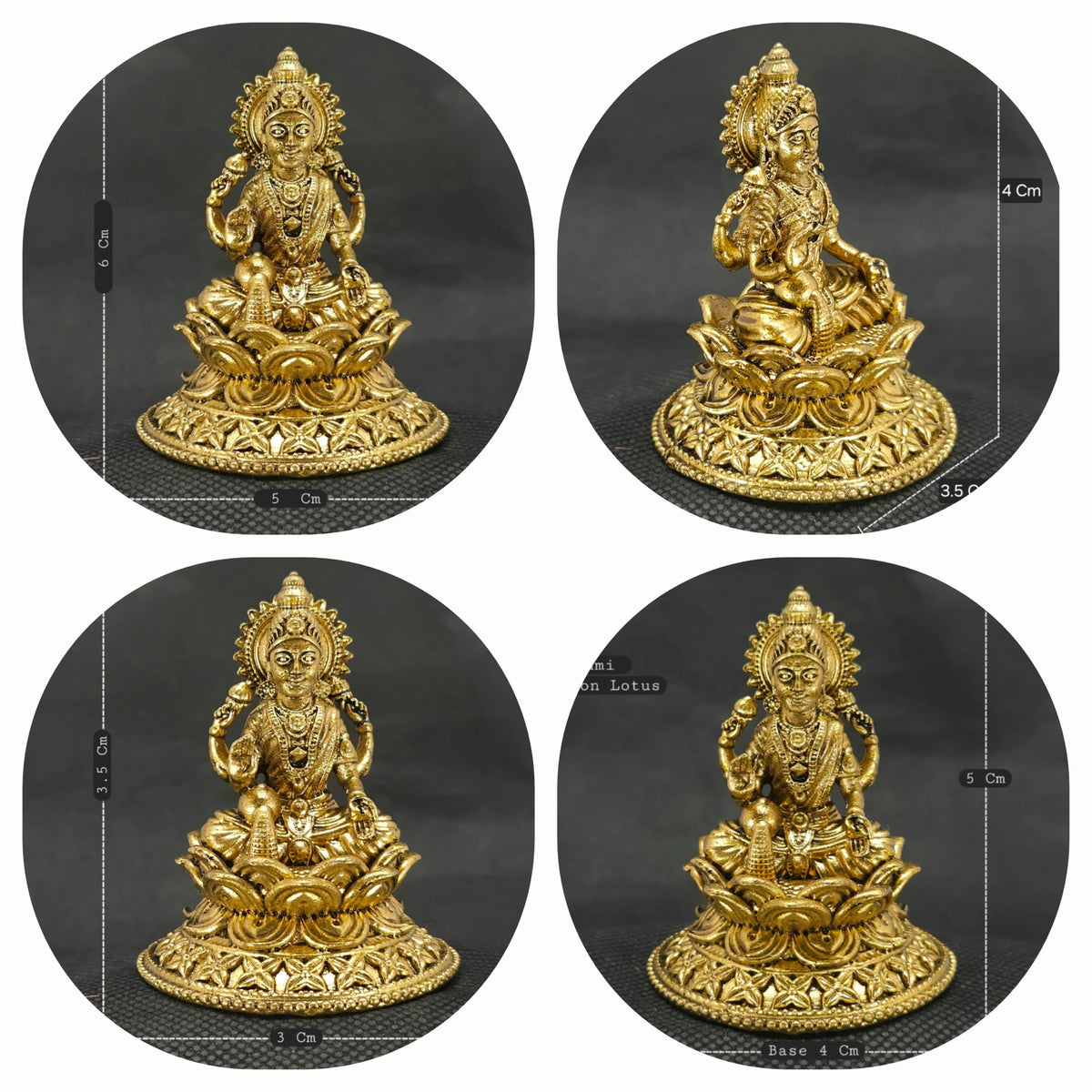
Aishwarya Lakshmi — The Goddess of Supreme Abundance, Seated on the Purna Padma
3D Brass Elite Collection · Premium Sacred Art · Museum-Quality Casting · Tamil Nadu
“She does not scatter coins from her hand. She holds a pot — the Purna Kumbha, the vessel of inexhaustible abundance — and from it, wealth flows in an unbroken stream. The hand does not run out. The pot does not empty. This is Aishwarya Lakshmi’s promise: not a gift of wealth, but a source of it.”
Among the Ashta Lakshmi — the eight supreme forms of the Goddess of Prosperity described in the Ashta Lakshmi Stotram — Aishwarya Lakshmi is the form of sovereign, inexhaustible abundance. Aishwarya in Sanskrit is not simply wealth. It is the sixfold divine sovereignty described in the Vishnu Purana: Bhaga — glory, Aisvarya — lordly power, Yashas — fame, Shri — beauty, Jnana — knowledge, and Vairagya — the inner freedom that prevents prosperity from becoming bondage. A home or business that receives Aishwarya Lakshmi’s blessing does not merely receive money. It receives all six dimensions of what it truly means to flourish. In this idol, the divine mother is seated in sovereign composure upon a luxuriously full, ornately based round lotus — the Purna Padma of complete fulfilment — adorned with the grandest of crowns and full sacred jewels, her four arms expressing the totality of her blessing, and from the Purna Kumbha resting at her right lap, a ceaseless stream of gold coins flows into the world. This 100% solid premium brass statue, cast using high-precision 3D detailed craft techniques by our master artisans, brings this complete and sovereign form of abundance directly into your home.
Her Sacred Form — What Every Detail Declares
▶ Four Hands — The Complete Grammar of Sovereign Abundance
Upper Two Hands — Lotus Buds
Both upper hands hold lotus buds — not the fully opened Purna Padma, but the bud: the form of abundance that is still becoming, still gathering itself before it opens completely. The Padma Purana describes the lotus bud in a deity’s hand as the symbol of potential held in readiness — the inexhaustible reserve that has not yet been released into the world. Aishwarya Lakshmi holds two such buds in her upper hands, declaring: what flows from the pot at my lap is not the entirety of my abundance. The buds I hold are what has not yet been given. The source is greater than the stream.
Lower Right Hand — Abhaya Mudra
The lower right hand is raised in Abhaya Mudra — the gesture of fearlessness and divine protection. This is not a secondary detail. Abundance without security is not a blessing — it is a weight. Aishwarya Lakshmi addresses this directly: her right hand declares that what is built under her blessing is protected. The prosperity she brings will not be stripped away. The family or business that receives her grace need not live in anxiety about what it has accumulated. She guards it.
Lower Left Hand — Varada Mudra
The lower left hand extends open in Varada Mudra — the gesture of unconditional giving. One hand protects what has been given. The other continues to give. Together, the two lower hands form the complete promise of a mother who neither withholds nor abandons: she gives, and then she guards what she has given.
The Purna Kumbha — The Pot of Inexhaustible Wealth at Her Right Lap
The Purna Kumbha — the full, overflowing pot — is one of the most ancient auspicious symbols in the Hindu tradition, appearing in temple doorways, in wedding rituals, and in the Ashta Mangala as a primary symbol of abundance. In Aishwarya Lakshmi’s iconography, the Purna Kumbha rests at her right lap and from it, gold coins flow in an unbroken stream into the world. The pot does not have a base that empties. It is Purna — complete, full, inexhaustible. The Lakshmi Tantra describes this symbol specifically: the kumbha is not a container of wealth. It is wealth’s own source — the point from which abundance issues continuously, without cause, without depletion, without end.
Upper Two Hands — Lotus Buds
Both upper hands hold lotus buds — not the fully opened Purna Padma, but the bud: the form of abundance that is still becoming, still gathering itself before it opens completely. The Padma Purana describes the lotus bud in a deity’s hand as the symbol of potential held in readiness — the inexhaustible reserve that has not yet been released into the world. Aishwarya Lakshmi holds two such buds in her upper hands, declaring: what flows from the pot at my lap is not the entirety of my abundance. The buds I hold are what has not yet been given. The source is greater than the stream.
Lower Right Hand — Abhaya Mudra
The lower right hand is raised in Abhaya Mudra — the gesture of fearlessness and divine protection. This is not a secondary detail. Abundance without security is not a blessing — it is a weight. Aishwarya Lakshmi addresses this directly: her right hand declares that what is built under her blessing is protected. The prosperity she brings will not be stripped away. The family or business that receives her grace need not live in anxiety about what it has accumulated. She guards it.
Lower Left Hand — Varada Mudra
The lower left hand extends open in Varada Mudra — the gesture of unconditional giving. One hand protects what has been given. The other continues to give. Together, the two lower hands form the complete promise of a mother who neither withholds nor abandons: she gives, and then she guards what she has given.
The Purna Kumbha — The Pot of Inexhaustible Wealth at Her Right Lap
The Purna Kumbha — the full, overflowing pot — is one of the most ancient auspicious symbols in the Hindu tradition, appearing in temple doorways, in wedding rituals, and in the Ashta Mangala as a primary symbol of abundance. In Aishwarya Lakshmi’s iconography, the Purna Kumbha rests at her right lap and from it, gold coins flow in an unbroken stream into the world. The pot does not have a base that empties. It is Purna — complete, full, inexhaustible. The Lakshmi Tantra describes this symbol specifically: the kumbha is not a container of wealth. It is wealth’s own source — the point from which abundance issues continuously, without cause, without depletion, without end.
The Purna Padma with Ornate Base — Her Throne of Complete Fulfilment
She is seated upon a round, luxuriously full lotus — the Purna Padma, every petal extended to its complete reach — set upon an ornately carved base that elevates the entire form in the Agamic tradition of the sacred pitha. The fully opened lotus beneath her declares that this is not the blessing of something still becoming. It is the blessing of full arrival — abundance already in complete flower, already present, already yours. The ornate base beneath the lotus further declares the Agamic principle: a goddess properly elevated on a decorated, consecrated pitha is more fully present in a space. The beauty of the throne is not vanity. It is the artisan’s offering — the visual declaration that this deity has been received with the honour her presence deserves.
Her Grand Crown and Sacred Jewels
The Kirita Mukuta — the tall, grand crown — and the full array of sacred jewels she wears are not ornamentation in the decorative sense. The Silpa Shastra prescribes every ornament of Lakshmi’s form with specific meaning: the crown declares her sovereignty over all the eight forms of prosperity. Her necklaces, armlets, earrings, and sacred thread each carry an attribute of the sixfold Aishwarya she embodies. When an idol of this goddess is rendered with full jewels and a complete crown, the artisan is not adding beauty — he is completing the iconographic statement. A Lakshmi without her full ornamentation is an incomplete Lakshmi. This form is complete.
The Sacred Blessings She Bestows
- Inexhaustible Abundance — the Purna Kumbha’s blessing: a source of wealth that does not deplete, that flows continuously through the home or business that honours her.
- Protection of Prosperity — the Abhaya Mudra’s blessing: what is built under her grace is guarded. Abundance without anxiety.
- Unconditional Giving — the Varada Mudra’s blessing: she gives because it is her nature, not in response to transaction. Sincere devotion is the only condition she names.
- Sovereign Glory — Aishwarya in its fullest meaning: not only material wealth but the sixfold prosperity of glory, power, fame, beauty, knowledge, and inner freedom.
- Held Reserve — the lotus bud’s blessing: what she has given is not the limit of what she holds. The buds in her upper hands declare that the source remains full.
- Business and Commercial Prosperity — Aishwarya Lakshmi is specifically invoked for businesses, trade, and commercial ventures. The Purna Kumbha’s overflowing wealth at the right lap directly blesses the enterprise placed beneath her gaze.
- Household Completeness — the fully opened lotus beneath her declares the home she enters to be a home of complete fulfilment — nothing essential missing, nothing important lacking.
Premium Solid Metal Artistry
This masterwork is cast from 100% solid premium brass using high-precision 3D detailed craft finishing techniques — zero hollow spaces, no gold spray-paint. Look closely at the Purna Kumbha at her right lap and the cascade of gold coins issuing from it, the two lotus buds held in her upper hands, the gestures of her lower hands, the individual petals of the full round lotus base, and the layered detail of her grand crown and jewels — every element rendered with museum-quality depth. The high-polish brass surface gives the goddess a natural golden radiance — the very quality that the Sri Suktam describes as the sign of Lakshmi’s active presence: “Hiranya varna” — the golden-hued one whose glow fills the home she enters. Built to handle generations of daily worship and Friday devotion.
▶ The Tradition’s Teaching on Welcoming Her
The Sri Suktam — the Rigvedic hymn to Lakshmi — does not describe the goddess as one who must be petitioned with elaborate ritual. It describes her as one who is drawn to certain qualities of space and person: cleanliness, sincerity, order, and dharmic effort. The Purna Kumbha in her lap is ready to pour. What the devotee provides is the space worthy of receiving what pours. A clean, well-maintained altar. A business or home where what is earned is earned honestly. A pooja space kept with genuine care, especially on Fridays. These are not conditions she imposes. They are the natural conditions under which she chooses to remain.
The Sri Suktam — the Rigvedic hymn to Lakshmi — does not describe the goddess as one who must be petitioned with elaborate ritual. It describes her as one who is drawn to certain qualities of space and person: cleanliness, sincerity, order, and dharmic effort. The Purna Kumbha in her lap is ready to pour. What the devotee provides is the space worthy of receiving what pours. A clean, well-maintained altar. A business or home where what is earned is earned honestly. A pooja space kept with genuine care, especially on Fridays. These are not conditions she imposes. They are the natural conditions under which she chooses to remain.
Altar Size Specifications
| Specification | 1.25" | 1.75" | 2.0" | 2.25" |
|---|---|---|---|---|
| Height | 3.5 cm 1.4 inch |
4.0 cm 1.6 inch |
5.0 cm 2.0 inch |
6.0 cm 2.4 inch |
| Base Diameter | 3.0 cm 1.2 inch |
3.5 cm 1.4 inch |
4.0 cm 1.6 inch |
5.0 cm 2.0 inch |
| Weight | ~25 g 0.9 oz |
~40 g 1.4 oz |
~50 g 1.8 oz |
~100 g 3.5 oz |
| Best Placement Indian |
Personal pooja tray, return gift, cash box corner | Pooja shelf, Friday worship altar, Diwali placement | Mandir padi, business wealth altar, Varalakshmi Vratam | Home temple centrepiece, primary wealth altar |
| Best Placement Global |
Wallet altar, desk corner, return gifting | Home office shrine, apartment altar, bookshelf | Living room sacred corner, business shrine | Primary home shrine, Diwali centrepiece |
All sizes are solid brass with identical 3D detail quality. Weights are approximate and may vary slightly.
Auspicious Occasions & Gifting
▶ Perfect for These Sacred Occasions
Diwali · Lakshmi Puja · Varalakshmi Vratam · Friday Pooja (Sukravara) · Navaratri · Akshaya Tritiya · Housewarming · Wedding gifts · Business inauguration · Shop opening · Corporate gifting · New financial year gifting
Especially meaningful for newlyweds beginning a home together · new business owners · families moving into a new house · devotees who observe Varalakshmi Vratam or Friday pooja regularly · anyone beginning a new financial chapter. The 1.25" size is perfect for return gifts and personal pooja trays. The 1.75" and 2" sizes are ideal for daily worship altars and business wealth placements. The 2.25" size is the premium choice for primary home temples and significant Diwali gifting. Recognised and treasured by devotees across India, Malaysia, Singapore, the Gulf, UK, and Australia.
Diwali · Lakshmi Puja · Varalakshmi Vratam · Friday Pooja (Sukravara) · Navaratri · Akshaya Tritiya · Housewarming · Wedding gifts · Business inauguration · Shop opening · Corporate gifting · New financial year gifting
Especially meaningful for newlyweds beginning a home together · new business owners · families moving into a new house · devotees who observe Varalakshmi Vratam or Friday pooja regularly · anyone beginning a new financial chapter. The 1.25" size is perfect for return gifts and personal pooja trays. The 1.75" and 2" sizes are ideal for daily worship altars and business wealth placements. The 2.25" size is the premium choice for primary home temples and significant Diwali gifting. Recognised and treasured by devotees across India, Malaysia, Singapore, the Gulf, UK, and Australia.
Cleaning & Maintenance
- Daily Dusting — wipe gently with a soft dry cloth. The lotus petal base, the Purna Kumbha detail, and the crown are best maintained with a soft brush.
- Gentle Washing — rinse with plain water and wipe dry with a soft cloth. Avoid letting water sit in the lotus petal grooves or the coin-cascade detail of the kumbha.
- Avoid Harsh Chemicals — no acidic cleaners, detergents, or abrasive pads. Plain water and a soft cloth preserve all 3D relief details.
- Natural Patina — over time, brass develops a warm golden-brown patina that is particularly auspicious on a Lakshmi idol — deepening gold tones are directly associated with her presence and the “Hiranya varna” quality described in the Sri Suktam. To restore original shine, rub gently with tamarind paste or a brass-polishing cloth.
- Friday Pooja — Sukravara is the sacred day of Lakshmi. A brief cleaning, a fresh flower offering, and a lamp lit before her on Fridays is the most traditional and effective practice for maintaining her active presence in the space.
- After Abhishekam — wipe dry immediately with a clean soft cloth, paying particular attention to the Purna Kumbha and lotus base detail.
- Storage — store in a clean dry cloth pouch away from moisture and direct sunlight when not in active use.
“The pot at her lap has no bottom that runs dry. The lotus buds in her upper hands have not yet opened. The hand she raises says: what you have will not be taken. The hand she extends says: and there is more still to come. This is Aishwarya Lakshmi — not the promise of prosperity. Its sovereign, inexhaustible source.”
Sri Swaminathan & Co · Since 1973 · Sacred Trust
Kumbakonam · Tamil Nadu · Trusted by Devotees & Collectors Across India & the World
Care & Maintenance
Made from super fine quality brass with a golden powder coated polish — gives a satin gold glow like a gold statue. Purely for decor and dry display. If used for pooja rituals, the golden polish layer will peel off over time. Keep it dry — and it will look as fresh as the day you bought it. Always.
No restrictions for pooja rituals. Avoid harsh chemicals to preserve its traditional antique look. The dark patina is intentional — it deepens the beauty over time.
Powerful. Preferred for active pooja rituals — no restrictions. Traditional Cleaning Method: Use dara liquid and cashew nut seeds — an ancient method used by temple priests for generations. Gently rub with cashew nut seeds dipped in dara liquid. Rinse clean. Your idol will look brand new. Cleaning once every 30 days is recommended if used regularly for pooja.
Frequently Asked Questions
We understand this completely. You are buying online from a shop you have never visited. Here is the truth: Sri Swaminathan & Co has been standing at 61, Bakthapuri Street, Kumbakonam since 1973 — over 53 years. We are not a warehouse or a reseller. We are a family shop, rooted in Kumbakonam, where priests, temples, and devotees from across Tamil Nadu have been coming for generations. Travellers from Singapore, Malaysia, UK, and USA visit us when they come to Kumbakonam — because they know us. You can walk into our shop any day. We are real.
Because most sites sell products. We sell legacy. Every item in our shop — whether it is a small brass lamp or a 4-foot Panchaloha idol — comes from craftsmen whose families have been doing this since the Chola period. We do not source from factories. We do not compromise on material or finish to reduce price. When you buy from us, you are not just getting a product — you are getting 53 years of trust, traditional craftsmanship, and the assurance that what you receive is exactly what a devotee deserves.
This is a fair concern and we respect it. Here is why we do not offer COD — our products are handcrafted, fragile, and carefully packed for safe delivery. COD returns damage both the product and the trust. Instead, we offer something better: WhatsApp us before you order. We will send you a video of the actual product — the exact piece you will receive. You can ask us anything. Only when you are fully satisfied, you pay. Our 53-year reputation is our guarantee — we cannot afford to let even one customer down.
Not at all — and we are glad you asked this. Our products are made of brass and Panchaloha — metals that naturally catch and reflect light from every angle. What you see as dark shades or bright reflections in photos is simply the metal doing what metal does — glowing, reflecting, and shining. We photograph every product as-is, with no filters, no AI, no editing. That reflection you see in the photo? You will see the same beautiful glow when it sits in your pooja room. It is not a defect — it is the character of real metal.
Yes — and here is why we say this with full confidence. Panchaloha idols require the right alloy, the right casting method, and the right finishing — done by craftsmen who understand the spiritual significance of what they are making. Our Panchaloha idols are hand-cast in Kumbakonam and Swamimalai by hereditary artisans using the traditional lost-wax method — the same method used to make idols for consecrated temples across South India. Priests trust our idols for temple installation. Families trust us for home pooja rooms. In 53 years, that trust has never been broken.