
Your Shopping Cart

OTHER PRODUCTS
-
 My Store
Fish Resin Craft 088
Regular price Rs. 7,200.00Regular priceUnit price perRs. 10,500.00Sale price Rs. 7,200.00 -
 My Store
Sri Swaminathan & Co Premium Gold Finish Resin Seven Carps Archway Statue (33 cm / 13 Inch)
Regular price Rs. 5,500.00Regular priceUnit price perRs. 9,500.00Sale price Rs. 5,500.00 -
 My Store
Sri Swaminathan & Co Royal Gold Dust Resin Nine Carps Wealth Pot Statue (24 cm / 9.5 Inch)
Regular price Rs. 2,850.00Regular priceUnit price perRs. 5,750.00Sale price Rs. 2,850.00


Sri Swaminathan & Co
INCLUSIVE OF ALL TAXES
Sri Swaminathan & Co Premium Brass Ganesha on Elephant Head Peedam
Sri Swaminathan & Co Premium Brass Ganesha on Elephant Head Peedam
Regular price
Rs. 250.00
Regular price
Rs. 350.00
Sale price
Rs. 250.00
Unit price
per
Shipping calculated at checkout.
SKU : 15686
Availability : In Stock
🚚 Free Shipping in India
above ₹1,000 | International shipping available
above ₹1,000 | International shipping available
📦 Safe Delivery
Zero Breakage Guarantee
Zero Breakage Guarantee
📹 WhatsApp Video
Before We Dispatch
Before We Dispatch
✅ Real Product Photos
No Filters. No AI.
No Filters. No AI.
🏆 53 Years of Trust
Kumbakonam's Finest
Kumbakonam's Finest
Couldn't load pickup availability
Shipping & Returns
Shipping & Returns
🚚 free shipping on all orders above ₹1,000 for India delivery only.
Tamil Nadu: 1-3 days
South India (outside Tamil Nadu): 2–5 days
Rest of India: 5–10 days
🌍 International shipping - International shipping charges will be added to the product price.
Call or WhatsApp us for shipping cost before ordering


Sri Swaminathan & Co · Since 1973 · Sacred Trust
Yanai Thalai Vinayagar — Lord Ganesha Enthroned on the Elephant Head Lotus Peedam
3D Brass Elite Collection · Premium Sacred Art · Museum-Quality Casting · Tamil Nadu
“The Ganapati Atharva Shirsha asks: who is this deity? And answers its own question: he is the one who, before the universe began, was already present. He is the first sound. He is the first witness. He has the head of the most ancient and most wise of all creatures — the elephant — and he sits on a throne of that same nature. Not because strength must bow to wisdom. But because in Ganesha, they were never two different things.”
Yanai Thalai Vinayagar — the Elephant Head Ganesha, a form unique in its iconographic depth and philosophical completeness — presents Lord Ganesha seated upon a lotus peedam that itself rests upon or emerges from the head of an elephant. To understand why this form carries such singular power, one must understand what the elephant means in the Hindu tradition, what Ganesha’s elephant head means, and what it signifies when the deity whose own head is that of the elephant chooses the elephant head as the very ground on which his lotus throne rests. This is not a form built for decoration. It is a form built for a specific and profound theological statement — one that the Mudgala Purana and the Ganapati Atharva Shirsha together make available to us. This 100% solid premium brass statue, cast using high-precision 3D detailed craft techniques by our master artisans, holds that statement in a form of extraordinary detail and beauty.
The Elephant Head Throne — The Theology of Self-Mastery
The elephant — Gaja in Sanskrit, Yanai in Tamil — holds a singular place in Hindu cosmology and royal tradition. The Gajendra Moksham episode of the Bhagavata Purana presents the elephant king Gajendra as a being of extraordinary nobility — powerful beyond measure, yet capable of deep devotion and the wisdom of surrender. The Arthashastra identifies the elephant as the supreme symbol of Gaja Lakshmi — royal prosperity, the abundance that commands respect, the wealth that carries with it authority and dignity. In temple architecture and in the Silpa Shastra, the elephant is placed at the base of sacred pillars and at the foundations of temple walls — not as a decorative motif but as the structural declaration that what rises above rests on the most stable, most powerful, and most auspicious of all earthly foundations. When Lord Ganesha — who himself bears the elephant’s head — chooses the elephant head as his throne’s foundation, the iconographer is making a statement that has no parallel in any other form: this is a deity who is not merely associated with the elephant’s qualities. He is the source from which those qualities arise. The elephant head beneath him does not elevate him. He completes it. The throne recognises its own master.
The Lotus Peedam — Purity Rising from Power
Between Ganesha and the elephant head below rises the lotus peedam — the lotus pedestal in full bloom. This placement carries a teaching that is uniquely expressed in this form: the lotus does not rise from water here, as it does in the cosmological descriptions of the Padma Purana. It rises from the elephant head. Purity rises from strength. Spiritual awakening — the fully opened lotus — does not require the absence of power. It emerges from power that has been rightly directed. The lotus peedam declares that Ganesha’s spiritual sovereignty — his role as the remover of obstacles, the giver of wisdom, the first among gods — is not separate from his commanding strength. It is built upon it, as the lotus is built upon the elephant’s head: inseparably, organically, with the lotus being the natural culmination of the power below it.
His Four Hands — The Complete Blessing
▶ What Each Hand Holds from the Elephant Head Throne
Abhaya Mudra with Om — The Commanding Protection
His palm raised in Abhaya Mudra carries the sacred syllable Om — the primordial sound that, the Ganapati Atharva Shirsha declares, belongs to Ganesha before all else: Tvam Omkarasya pratikam asi — You are the very form of Om. From the elephant head throne, this mudra carries an additional weight: when the lord of all elephantine strength raises his hand in protection, that protection has the full force of the most powerful of all earthly creatures behind it, refined into divine will. What his Om-inscribed palm protects cannot be shaken.
Parashu — The Axe of Divine Will
The Parashu in Ganesha’s hand is the instrument of Ajna Shakti — the divine will that commands obstacles to yield — as the Mudgala Purana describes in its cataloguing of Ganesha’s thirty-two forms. From the elephant head throne, the axe is particularly potent: the strength of the elephant beneath him and the decisive authority of the axe in his hand speak in the same language. The obstacle does not merely yield. It has nowhere to stand.
Aksha Mala — The Prayer Beads of Wisdom
As Buddhi Pradayaka — the giver of intelligence — Ganesha holds the Aksha Mala to declare his blessing on all intellectual and creative work. The elephant is the tradition’s supreme symbol of memory and intelligence — the Matanga Lila and the Hastyayurveda both record the elephant’s extraordinary cognitive and emotional capacity. When Ganesha holds the prayer beads above an elephant head throne, the blessing of intelligence is doubled: the wisdom of the deity and the remembered intelligence of the elephant foundation below both flow toward the devotee who comes to this form for help with learning, with study, with creative work, with any endeavour of the mind.
Modaka — The Fruit of Wisdom
The Modaka — the Jnana Phala, the fruit of wisdom — sweet all the way to its seed. The Ganesha Purana identifies the Modaka as the reward of a life lived with all obstacles cleared, inner and outer. From the elephant head throne, the Modaka promises what only Yanai Thalai Vinayagar’s specific combination can deliver: the reward of wisdom sustained by strength, of achievement supported by the most powerful of all foundations.
Abhaya Mudra with Om — The Commanding Protection
His palm raised in Abhaya Mudra carries the sacred syllable Om — the primordial sound that, the Ganapati Atharva Shirsha declares, belongs to Ganesha before all else: Tvam Omkarasya pratikam asi — You are the very form of Om. From the elephant head throne, this mudra carries an additional weight: when the lord of all elephantine strength raises his hand in protection, that protection has the full force of the most powerful of all earthly creatures behind it, refined into divine will. What his Om-inscribed palm protects cannot be shaken.
Parashu — The Axe of Divine Will
The Parashu in Ganesha’s hand is the instrument of Ajna Shakti — the divine will that commands obstacles to yield — as the Mudgala Purana describes in its cataloguing of Ganesha’s thirty-two forms. From the elephant head throne, the axe is particularly potent: the strength of the elephant beneath him and the decisive authority of the axe in his hand speak in the same language. The obstacle does not merely yield. It has nowhere to stand.
Aksha Mala — The Prayer Beads of Wisdom
As Buddhi Pradayaka — the giver of intelligence — Ganesha holds the Aksha Mala to declare his blessing on all intellectual and creative work. The elephant is the tradition’s supreme symbol of memory and intelligence — the Matanga Lila and the Hastyayurveda both record the elephant’s extraordinary cognitive and emotional capacity. When Ganesha holds the prayer beads above an elephant head throne, the blessing of intelligence is doubled: the wisdom of the deity and the remembered intelligence of the elephant foundation below both flow toward the devotee who comes to this form for help with learning, with study, with creative work, with any endeavour of the mind.
Modaka — The Fruit of Wisdom
The Modaka — the Jnana Phala, the fruit of wisdom — sweet all the way to its seed. The Ganesha Purana identifies the Modaka as the reward of a life lived with all obstacles cleared, inner and outer. From the elephant head throne, the Modaka promises what only Yanai Thalai Vinayagar’s specific combination can deliver: the reward of wisdom sustained by strength, of achievement supported by the most powerful of all foundations.
The Pearl Halo — Divine Grace Radiating from the Throne
Behind Ganesha’s head rises an ornate pearl halo — the Prabha Mandala adorned with pearl-bordered detail. In the Agamic tradition, pearl borders on a sacred object carry the symbolism of purity and the ocean’s depth — the pearl being born from the deepest waters, formed through patience, a symbol of spiritual perfection achieved through sustained effort. A pearl-bordered Prabha Mandala behind Ganesha’s head declares his spiritual radiance to be of this quality: deep, patient, perfected. The Tejas that radiates from this halo — the divine luminosity described in the Markandeya Purana — reaches outward from the elephant head throne, sanctifying the space around the idol in every direction, with the full combined force of strength below and grace above.
The Sacred Blessings He Bestows from This Throne
- Vigna Nashana — Obstacle Removal with Sovereign Authority — from the elephant head throne, the Parashu’s obstacle-removing power is at its most complete. The strength of the elephant and the decisive will of the axe operate together.
- Gaja Bala — The Blessing of Elephant-Strength — the Gaja Lakshmi tradition blesses the devotee with the prosperity that carries dignity and commands respect. Not just wealth, but the authority and stability that the elephant represents.
- Buddhi and Smriti — Intelligence and Memory — the doubled blessing of the Aksha Mala above the elephant head: Ganesha’s gift of intelligence reinforced by the elephant’s own legendary memory and cognitive depth.
- Fearless Achievement — the Om-inscribed Abhaya Mudra from the strength of the elephant throne: protection that carries the full weight of the most powerful of all foundations. What is attempted under this protection cannot easily be stopped.
- Self-Mastery — the deepest blessing of this specific form: the deity who masters the elephant head is the deity who has mastered his own most powerful nature. For devotees engaged in any discipline of self-development — physical, mental, or spiritual — Yanai Thalai Vinayagar is the specific form of Ganesha who blesses this work most directly.
- Auspicious Beginnings — Ganesha is invoked before every undertaking. From the elephant head throne, this invocation carries the additional force of royal elephantine authority: the beginning blessed by Yanai Thalai Vinayagar begins with both wisdom and the strength to see it through.
Premium Solid Metal Artistry
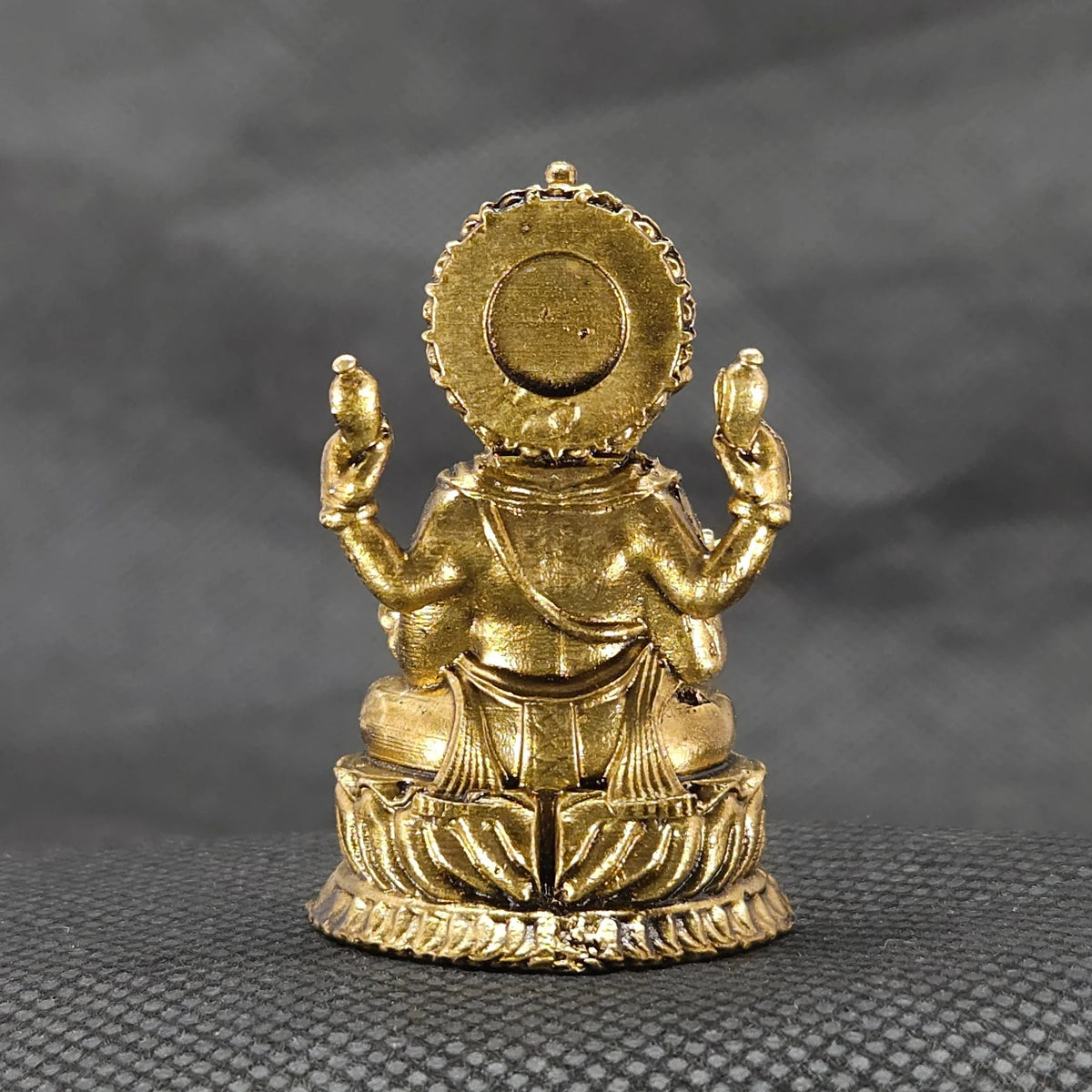
This masterwork is cast from 100% solid premium brass using high-precision 3D detailed craft finishing techniques — zero hollow spaces, no gold spray-paint. Look closely at the elephant head at the base — the facial features, the curve of the trunk, the detail of the ears and crown — each element a separately rendered relief. Above it, the lotus peedam with its individually detailed petals. Above that, Ganesha himself: the Om symbol on his raised palm, the pearl-bordered halo behind his head, the Parashu and Aksha Mala and Modaka in his other hands, and the full detail of his crown and jewels. Every layer of this three-tiered form — elephant head, lotus peedam, Ganesha — rendered with museum-quality depth in a single unified object of 4.5 cm height. The warm golden glow of hand-polished brass gives the entire form a natural authority that no painted or coated surface can match. Built to handle generations of daily worship.
Sacred Specifications
| Specification | Details |
|---|---|
| Height | 4.5 cm / 1.8 inch |
| Length | 3.0 cm / 1.2 inch |
| Width | 2.5 cm / 1.0 inch |
| Weight | ~30 g / 1.1 oz |
| Material | 100% Solid Premium Brass |
| Craft | 3D High-Precision Mould Casting |
| Throne Structure | Elephant Head · Lotus Peedam · Ganesha — three-tiered sacred form |
| Best Placement — Indian | Pooja shelf, study table, office desk, return gift, vehicle altar |
| Best Placement — Global | Home shrine, desk corner, bookshelf altar, gifting |
Single size available. Weight is approximate and may vary slightly.
Auspicious Occasions & Gifting
▶ Perfect for These Sacred Occasions & As a Return Gift
Vinayaka Chaturthi · Ganesh Chaturthi · Housewarming · Wedding gifts · Business inauguration · Upanayana · Annaprasana · Shashtiabdhapoorthi · Exam blessings and new academic year · Corporate gifting for leadership roles · Return gifts for all auspicious functions
At its size and price, Yanai Thalai Vinayagar is among the most compelling return gifts available — small enough to gift in quantity, significant enough in its iconography and craft to be kept and honoured for a lifetime. A guest who receives this idol receives Ganesha from his most powerful throne — a form that most will never have seen before, and will not forget. Recognised and treasured by devotees across India, Malaysia, Singapore, the Gulf, UK, and Australia.
Vinayaka Chaturthi · Ganesh Chaturthi · Housewarming · Wedding gifts · Business inauguration · Upanayana · Annaprasana · Shashtiabdhapoorthi · Exam blessings and new academic year · Corporate gifting for leadership roles · Return gifts for all auspicious functions
At its size and price, Yanai Thalai Vinayagar is among the most compelling return gifts available — small enough to gift in quantity, significant enough in its iconography and craft to be kept and honoured for a lifetime. A guest who receives this idol receives Ganesha from his most powerful throne — a form that most will never have seen before, and will not forget. Recognised and treasured by devotees across India, Malaysia, Singapore, the Gulf, UK, and Australia.
Cleaning & Maintenance
- Daily Dusting — wipe gently with a soft dry cloth. The elephant head detail, lotus petal layers, and pearl halo border are best maintained with a soft brush.
- Gentle Washing — rinse with plain water and wipe dry with a soft cloth. Pay care to drying between the lotus petal layers and the carved detail of the elephant head.
- Avoid Harsh Chemicals — no acidic cleaners, detergents, or abrasive pads. Plain water and a soft cloth preserve all 3D relief details.
- Natural Patina — over time, brass develops a warm golden-brown patina that settles with particular beauty into the elephant head’s facial detail and the lotus petal layers — deepening the visual contrast and three-dimensional richness of the entire form. This is natural and auspicious. To restore original shine, rub gently with tamarind paste or a brass-polishing cloth.
- Storage — store in a clean dry cloth pouch away from moisture and direct sunlight when not in active use.
“The elephant does not bow to Ganesha because it was commanded to. It offers its head as a throne because it recognises, in the deity who shares its nature, the source from which its own nobility comes. This is the deepest meaning of Yanai Thalai Vinayagar: strength does not oppose wisdom. Rightly understood, strength has always been wisdom’s most devoted servant.”
What you see on this page is the real product — photographed as it is, with no digital editing or AI enhancement. The idol you receive will look exactly as shown.
Sri Swaminathan & Co · Since 1973 · Sacred Trust
Kumbakonam · Tamil Nadu · Trusted by Devotees & Collectors Across India & the World
Care & Maintenance
Made from super fine quality brass with a golden powder coated polish — gives a satin gold glow like a gold statue. Purely for decor and dry display. If used for pooja rituals, the golden polish layer will peel off over time. Keep it dry — and it will look as fresh as the day you bought it. Always.
No restrictions for pooja rituals. Avoid harsh chemicals to preserve its traditional antique look. The dark patina is intentional — it deepens the beauty over time.
Powerful. Preferred for active pooja rituals — no restrictions. Traditional Cleaning Method: Use dara liquid and cashew nut seeds — an ancient method used by temple priests for generations. Gently rub with cashew nut seeds dipped in dara liquid. Rinse clean. Your idol will look brand new. Cleaning once every 30 days is recommended if used regularly for pooja.
Frequently Asked Questions
We understand this completely. You are buying online from a shop you have never visited. Here is the truth: Sri Swaminathan & Co has been standing at 61, Bakthapuri Street, Kumbakonam since 1973 — over 53 years. We are not a warehouse or a reseller. We are a family shop, rooted in Kumbakonam, where priests, temples, and devotees from across Tamil Nadu have been coming for generations. Travellers from Singapore, Malaysia, UK, and USA visit us when they come to Kumbakonam — because they know us. You can walk into our shop any day. We are real.
Because most sites sell products. We sell legacy. Every item in our shop — whether it is a small brass lamp or a 4-foot Panchaloha idol — comes from craftsmen whose families have been doing this since the Chola period. We do not source from factories. We do not compromise on material or finish to reduce price. When you buy from us, you are not just getting a product — you are getting 53 years of trust, traditional craftsmanship, and the assurance that what you receive is exactly what a devotee deserves.
This is a fair concern and we respect it. Here is why we do not offer COD — our products are handcrafted, fragile, and carefully packed for safe delivery. COD returns damage both the product and the trust. Instead, we offer something better: WhatsApp us before you order. We will send you a video of the actual product — the exact piece you will receive. You can ask us anything. Only when you are fully satisfied, you pay. Our 53-year reputation is our guarantee — we cannot afford to let even one customer down.
Not at all — and we are glad you asked this. Our products are made of brass and Panchaloha — metals that naturally catch and reflect light from every angle. What you see as dark shades or bright reflections in photos is simply the metal doing what metal does — glowing, reflecting, and shining. We photograph every product as-is, with no filters, no AI, no editing. That reflection you see in the photo? You will see the same beautiful glow when it sits in your pooja room. It is not a defect — it is the character of real metal.
Yes — and here is why we say this with full confidence. Panchaloha idols require the right alloy, the right casting method, and the right finishing — done by craftsmen who understand the spiritual significance of what they are making. Our Panchaloha idols are hand-cast in Kumbakonam and Swamimalai by hereditary artisans using the traditional lost-wax method — the same method used to make idols for consecrated temples across South India. Priests trust our idols for temple installation. Families trust us for home pooja rooms. In 53 years, that trust has never been broken.